best cheap VPN: quick answer
The cheapest VPN is almost never the one with the lowest advertised price. Every major provider markets a heavily discounted two- or three-year first term and then renews at a substantially higher rate — so the number that decides what you actually spend is the one nobody puts on a landing page.
This guide ranks the best cheap VPN options on three-year total cost, not signup price, and on cost per device, which is where the real differences hide. It also covers what's safe to compromise on at the budget end and what isn't, because a VPN that's cheap by cutting the wrong thing is worse than no VPN at all.
The pricing trap, explained once
Here's the pattern used across the entire industry.
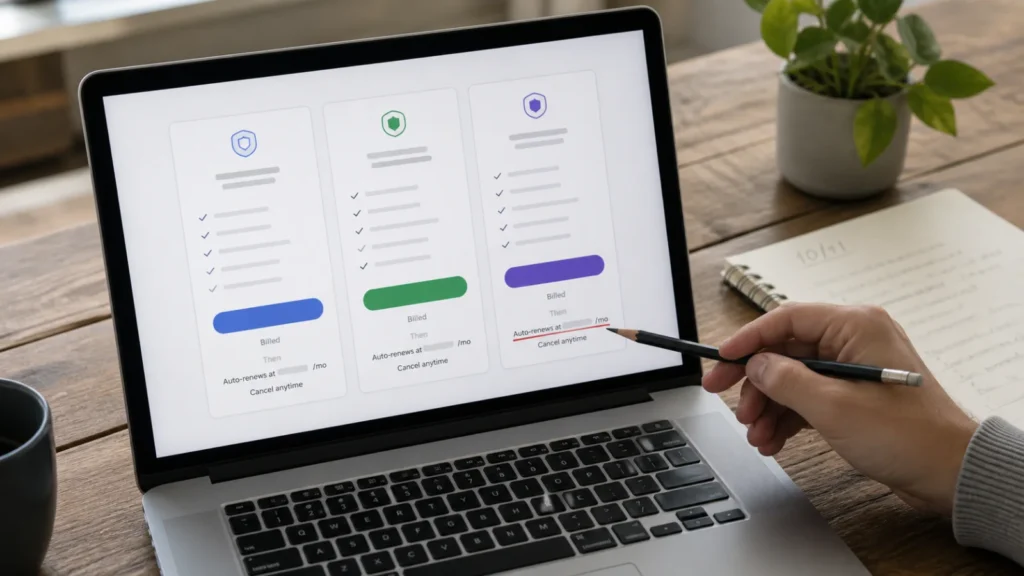
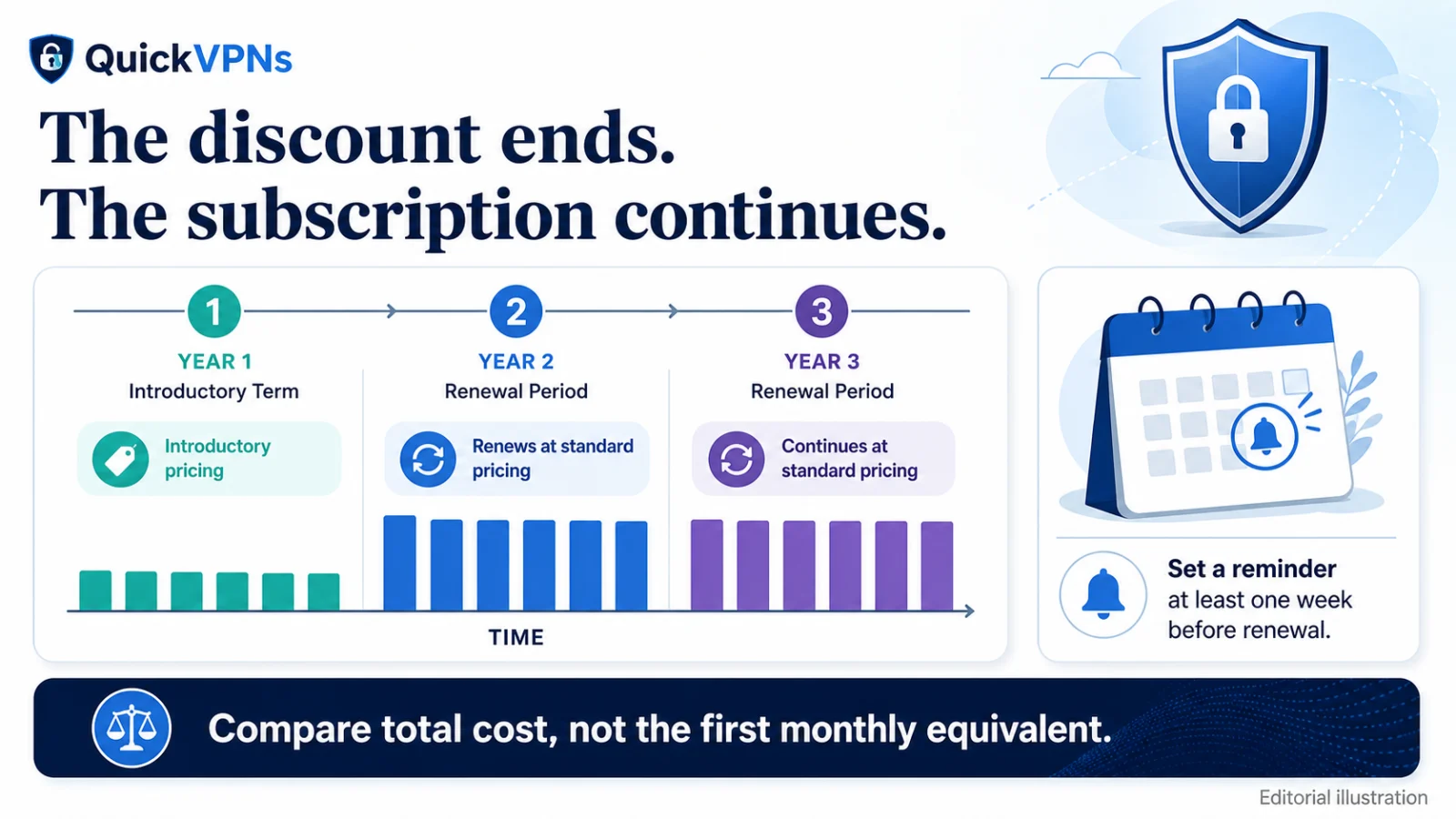
You see a very large discount on a two- or three-year plan. You pay that amount up front for the whole term. When the term ends, the subscription renews automatically at a much higher rate — often several times the effective monthly price you signed up at.
None of this is hidden. It's stated on the pricing page, usually in smaller text near the plan selector. But it's designed to be skimmed past while you're looking at the discount percentage.
Three rules that follow:
- Compare renewal prices, not intro prices. If the renewal wouldn't feel like good value, the discount shouldn't persuade you.
- Set a calendar reminder a week before the term ends. That's when you decide to renew, negotiate or switch — not after the charge appears.
- Compare like tiers. Some providers keep their headline features on higher plans. A cheap entry tier that excludes the feature you're buying it for isn't cheap.
Compare the provider options
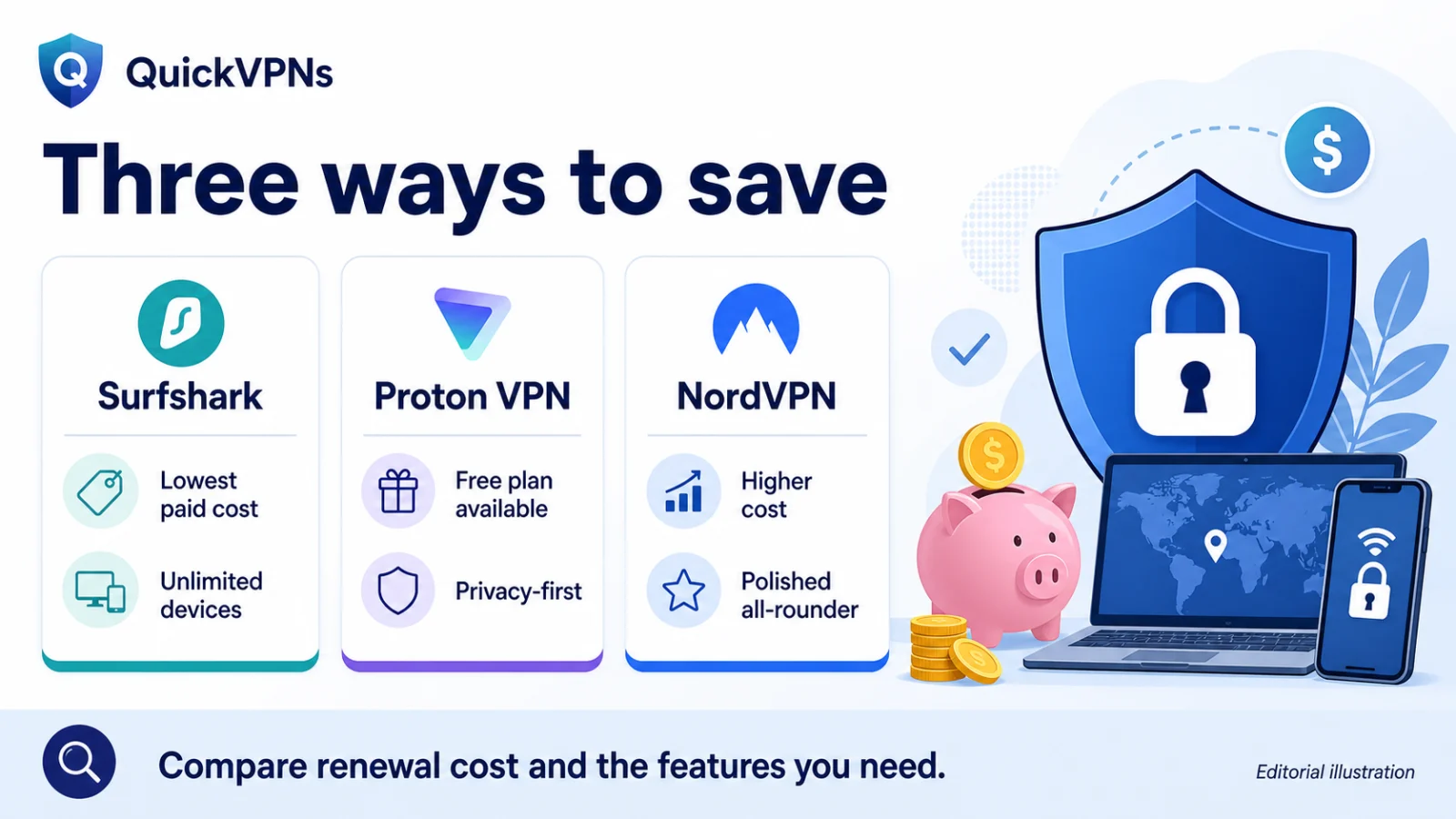
Use the current plan pages for live terms; the trade-offs below are the stable decision points.
NordVPN
- Strong support for restrictive networks
- Broad server and TV-device coverage
- Ten simultaneous device connections
Surfshark
- Unlimited simultaneous device connections
- Strong value for households
- Some features differ by platform
Proton VPN
- Open-source apps and published privacy evidence
- Privacy-focused free and paid options
- Advanced features depend on the plan
Quick comparison
| Surfshark | Proton VPN | NordVPN | |
|---|---|---|---|
| Best for | Cheapest paid plan, most devices | Cheapest possible (free tier) | When you need what it does |
| Our rating | 4.5 / 5 | 4.6 / 5 | 4.7 / 5 |
| Relative cost at signup | Lowest | Middle | Highest |
| Relative cost at renewal | Lowest | Middle | Highest |
| Devices per subscription | Unlimited | 10 | 10 |
| Effective cost per device | Lowest by far | Middle | Highest |
| Free tier | No | Yes — no data cap | No |
| Independent audits | 2 | 5 consecutive | 6 |
| Money-back guarantee | 30 days | 30 days | 30 days |
Surfshark → · Proton VPN → · NordVPN →
1. Surfshark — cheapest paid plan, and it isn't close on cost per device
4.5 / 5 · unlimited devices · 4,500+ servers in 100 countries
Surfshark is the cheapest of the major providers at signup and — more importantly — at renewal. But the headline price understates the gap, because of one policy.
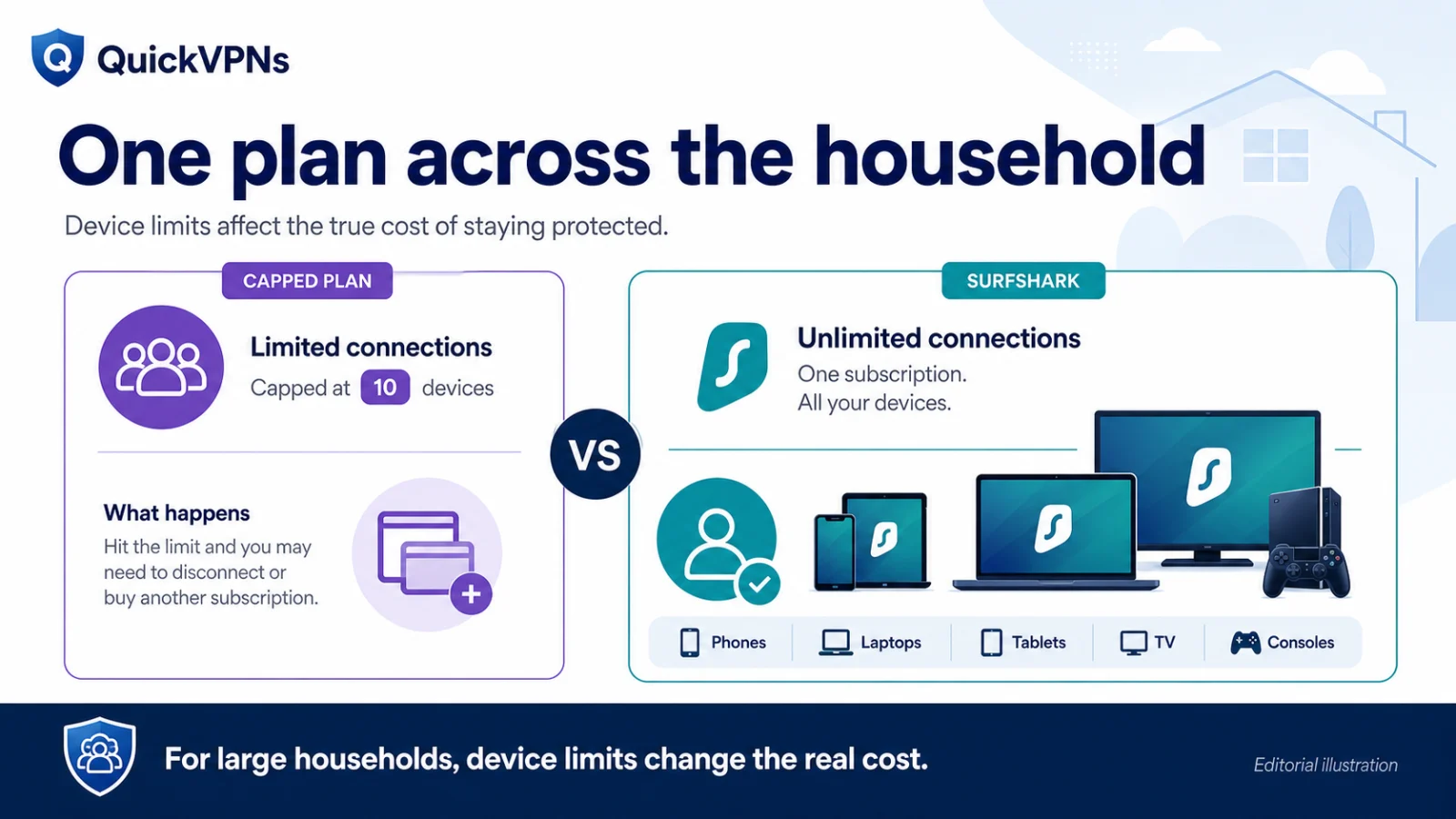
Unlimited simultaneous connections. Every competitor caps you at 5–10. Count your household honestly: two phones, two laptops, a tablet, a work machine, a Fire Stick, a smart TV. You're past ten. With a capped provider you'd need a second subscription; with Surfshark you need nothing extra.
So the real comparison for a household isn't Surfshark's price against NordVPN's price. It's Surfshark's price against two of anything else — and at that point it isn't a close call.
What makes it a legitimate recommendation rather than just a cheap one is that the compromises aren't in the parts you touch. NoBorders automatically finds servers that work on restricted networks. Everlink restores dropped tunnels instantly, which is what makes a VPN survivable on unreliable Wi-Fi. CleanWeb blocks ads, trackers and malicious domains. Bypasser handles split tunnelling in both directions.
The genuine weakness is audit depth: two independent no-logs audits by Deloitte, in 2023 and 2025, against six for NordVPN and five for Proton VPN. Surfshark does publish the complete ISAE 3000 report as a PDF rather than a summary — better disclosure, shorter record.
Pros
- Lowest cost of the three at signup and renewal
- Unlimited devices makes cost per device dramatically lower
- Feature set is full, not stripped — NoBorders, Everlink, CleanWeb, split tunnelling
- Publishes the complete audit report
Cons
- Only two independent audits
- Smallest network of the three
- Some features are platform-specific
- No free tier, so you can't test without paying
Best for: households, anyone with more than four devices, and anyone who wants the lowest real cost without a stripped-down product.
2. Proton VPN — the cheapest option is free, and it's real
4.6 / 5 · free plan with no data cap · 20,000+ servers in 140+ countries on paid
Any honest "cheap VPN" guide has to acknowledge that the cheapest legitimate option costs nothing.
Proton VPN Free has no data cap, no ads, no speed throttling and no activity logging — the only major free VPN that can claim all four. It's funded by paid Proton subscriptions rather than by monetising free users, and the no-logs claim is backed by five consecutive independent audits plus open-source apps on every platform.
The limits are one device, a small set of countries, and no streaming. For a single person who wants protection on café Wi-Fi, that's often the entire requirement — and paying for more would be paying for what you won't use.
The paid tier sits in the middle of the market on price, and buys the largest server network here, Secure Core multi-hop, NetShield filtering and 10 devices.
One caveat specific to Proton: the suite bundle with Mail, Drive, Pass and Calendar is genuinely economical if you'd use those services. If you only want a VPN, compare the VPN-only tier and ignore how good the suite maths looks.
Pros
- Free tier is genuinely usable — the cheapest legitimate option anywhere
- Five consecutive audits and open-source apps at any price point
- Largest network of the three on paid plans
- You can evaluate everything before paying anything
Cons
- Free tier is one device and a handful of countries
- No streaming on free
- Paid tier costs more than Surfshark for fewer devices
- Bundle pricing can obscure the VPN-only comparison
Best for: single users with modest needs, anyone testing whether they need a VPN at all, and anyone who wants a zero-cost backup alongside a paid service.
3. NordVPN — the most expensive, and sometimes still the right call
4.7 / 5 · 7,400+ servers in 118 countries · 10 devices
NordVPN is the most expensive of the three at renewal, and it belongs in a "cheap VPN" guide for one reason: cheap is relative to what you need it to do.
If you're travelling somewhere that actively blocks VPN traffic, a subscription that can't connect costs you 100% of what you paid. NordVPN's NordWhisper disguises VPN traffic as ordinary web traffic and has the strongest record here on hostile networks. If that's your situation, it's the cheapest option that works — which is the only kind of cheap that matters.
The same logic applies to streaming on a TV. SmartPlay plus native apps for Android TV, Apple TV and Fire TV Stick is the least effortful setup available. And it carries six independent no-logs assurance engagements, the longest verification record in the category.
Where it's genuinely poor value: if you don't need obfuscation, don't stream on TV devices, and don't weight audit count heavily, you're paying a premium for capabilities you won't use. Be honest about which of those apply to you.
Also check the tier carefully — Threat Protection Pro and Dark Web Monitor aren't on the entry plan, so the cheapest NordVPN tier isn't the one most reviews describe.
Pros
- Best connection record on restricted networks
- Six no-logs assurance engagements — longest available
- Widest device platform support, including three TV platforms
- SmartPlay removes streaming configuration entirely
Cons
- Highest renewal cost of the three
- 10 devices, so a household may need two subscriptions
- Distinctive features gated to higher tiers
- No free tier
Best for: travellers to restrictive countries and TV-based streamers — the two cases where the premium is genuinely earned.
What's safe to compromise on — and what isn't
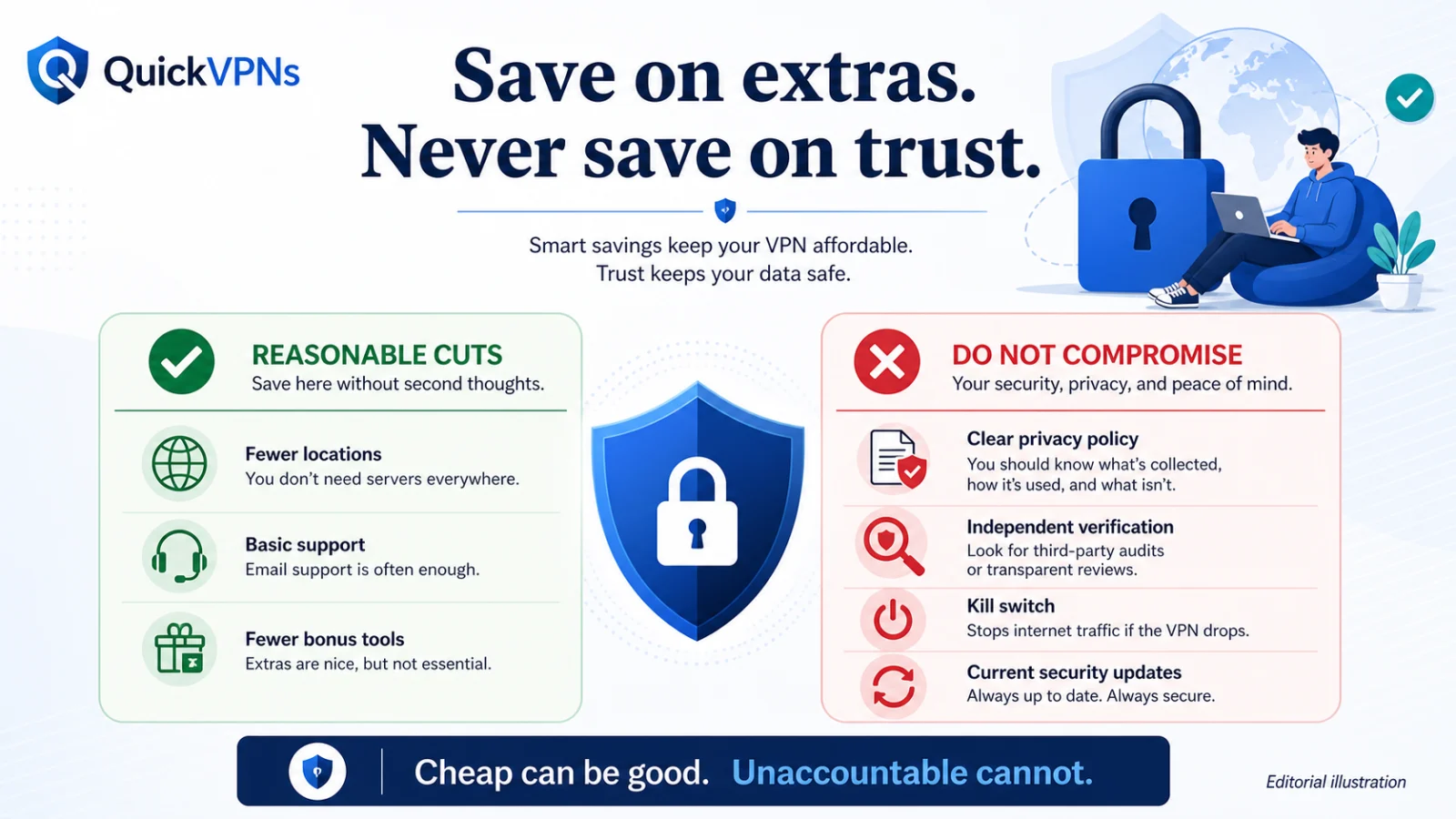
The useful question at the budget end isn't "how cheap can I go" but "what am I giving up."
Safe to compromise on:
- Server count. 4,500 well-placed servers beats 20,000 badly placed ones. Check coverage in countries you actually use.
- Specialty servers. Double VPN, Onion over VPN, dedicated IP — most people never enable them.
- Bundled extras. Antivirus and breach monitoring are fine if you'd otherwise buy them, worthless if you wouldn't.
- Marginal speed differences. Any modern WireGuard-based protocol clears 4K comfortably.
Not safe to compromise on:
- An independent no-logs audit. This is the one claim you can never verify yourself. A cheap VPN without one isn't cheap, it's unverified.
- A working kill switch. Test it in the refund window: connect, drop Wi-Fi, confirm traffic stops.
- DNS handled inside the tunnel. Without it, your ISP still has a list of every site you visited and the encryption bought you very little.
- A clear funding model. If a provider is very cheap or free with no explanation of who pays, assume you're the product. We covered this in free VPN vs paid VPN.
Avoid entirely: "lifetime" VPN subscriptions. A business with recurring costs funded by a one-off payment has to make money elsewhere, and the history of that model in this category is poor.
Which cheap VPN should you choose?
| Your situation | Pick |
|---|---|
| One device, occasional use | Proton VPN Free — don't pay yet |
| A household, several devices | Surfshark — lowest cost per device by far |
| Lowest paid price overall | Surfshark |
| Privacy on a budget | Proton VPN — audits and open source at any tier |
| Travelling somewhere that blocks VPNs | NordVPN — the cheapest thing that works |
| Streaming on a TV | NordVPN |
Final thoughts
Cheap in this category is a two-number question: what you pay at renewal, and how many devices that covers. On both, Surfshark wins clearly, and it does so without the stripped-down feature set that usually accompanies a low price.
If your needs are genuinely small, Proton VPN Free is cheaper still — free, uncapped and audited — and you shouldn't spend money you don't need to.
And if you're travelling somewhere that blocks VPNs or streaming on a TV, NordVPN costs more and is still the right answer, because a cheap subscription that doesn't do the job is the most expensive option on the page.
How we evaluated best cheap VPN
QuickVPNs compared the documented features that change the reader’s outcome, checked current Provider Hub sources, removed volatile price claims, and stated limitations alongside strengths. No provider can buy a ranking.
| Criterion | What we checked |
|---|---|
| Evidence | Current official documentation and independent assurance material where available |
| Real-world fit | Devices, network conditions, setup effort, and meaningful limitations |
| Value | Coverage and durable features, not a temporary introductory price |
best cheap VPN FAQ
What is the cheapest VPN that's actually worth using?
Surfshark is the cheapest paid option at signup and renewal, and unlimited devices makes its cost per device dramatically lower than anything else. If you only need one device, Proton VPN Free costs nothing and has no data cap — the cheapest legitimate option available.
Why do VPNs get more expensive after the first term?
Every major provider markets a heavily discounted multi-year first term and renews at a substantially higher rate. It's disclosed on the pricing page but easy to skim past. Compare renewal prices when choosing, and set a reminder before your term ends.
Are cheap VPNs safe?
They can be — Surfshark is inexpensive and independently audited twice by Deloitte, with the full report published. The problem isn't price, it's unverified claims. A cheap VPN with a recent independent no-logs audit is fine; a cheap one without any audit is a risk regardless of price.
Is it worth paying more for NordVPN?
Only if you need what the premium buys: reliable connection on networks that block VPNs, or effortless streaming on TV devices. If neither applies, you're paying for capability you won't use and Surfshark covers the same ground for less.
Should I buy a lifetime VPN subscription?
No. Running a VPN has ongoing costs, so a provider funded by one-off payments has to monetise something else eventually — usually your data, or by degrading the service. Every reputable provider here uses recurring subscriptions with a 30-day money-back guarantee instead.
Continue with the VPN Guides hub
Browse all VPN Guides, visit the related topic guide, or compare the best VPN services.